
The Violet Hour
A Review of James Cahill's New Novel

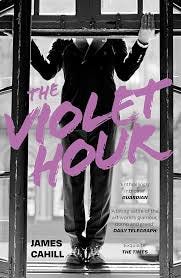
James Cahill received much acclaim for his first novel, Tiepolo Blue, in which a respected professor, an expert on the painter Tiepolo, sees his life go downhill as he ends up running an art museum in south London and falling in love with a young male artist. Cahill’s second novel, The Violet Hour, continues his exploration of the contemporary art world and of contemporary modes of sexuality. The novel’s three major characters are Thomas Haller, a world-famous painter known for large abstract, color-field paintings; Lorna Bedford, a New York gallery owner who had a very brief affair with Thomas long ago and represents him commercially; and Leo Goffman, a wealthy New York real estate magnate with one of the world’s greatest private collections of 20th-century art.
“The violet hour” of the title comes, it appears, from Eliot’s The Waste Land, where the phrase is mentioned twice. There it represents the twilight moment when day is turning into evening but also, in Eliot’s poem, a time for casual sexual affairs ranging from the unsatisfying to the sordid. (It is possible that Cahill may also have in mind Oscar Wilde’s confession about enjoying “violet hours” with young male prostitutes; it was around Wilde’s time that violet, purple, lavender, and mauve became associated with sexual decadence.) If one recalls Tiepolo Blue, one might expect, given the new title’s reference to Eliot’s work, that the structural and thematic obsessions of Eliot’s poem would dominate the arrangement of the new novel. For in that first novel, Thomas Mann’s Death in Venice provides the architectural pattern, often in very considerable detail, for the latter half of the book. But here references to Eliot’s poem are merely playful and are far less dominant in providing the narrative structure. At a gallery opening, one character quotes “I see crowds of people, walking around in a ring,” which seems Eliot’s own reference to the punishment of sodomites in Dante’s hell. For the sale of a painting where the seller wishes to remain hidden, a shell company called Equitone is formed. ‘Equitone’ is the name of the person to whom Madame Sesostris in Eliot is sending a reading and thus Sesostris as a medium is here associated with this particular entity as a business-deal “medium”. As in The Waste Land, Lake Geneva is here referred to as Lac Léman and we know that Eliot spent time in Lausanne, on Lake Geneva, when writing The Waste Land and we learn that Thomas was born and now lives outside of Montreux. Leo asks another character “Do you think men or women get greater pleasure from lovemaking?,” thus recalling Eliot’s Tiresias. At a gallery opening, a stranger accosts Thomas with the phrase “you were with me at Kassel,” evoking the phrase “you were with me in the ships at Mylae” in Eliot’s poem. (Kassel is the site of the art-world affair called Documenta.) When Thomas says that he lives in the mountains because there he feels free, that is a near quote from The Waste Land, where the phrase is taken from a song devoted to Ludwig II.
Those playful references, as I said, do not dominate the structure or thematics of the novel. It is concerned rather with different attitudes toward contemporary art. Lorna’s younger girlfriend Justine (perhaps soon-to-be ex-girlfriend) believes that Haller represents many of the most hateful aspects of present-day culture. His paintings aim to make heroic, masculine gestures that suit the world, so she claims, of patriarchy and neoliberalism. In graduate school she was once a devoted follower of Henry James and liked to form sentences modeled after his in her speech. But she has thoroughly given up that form of gay aesthetics owing to James and now believes that literary and art criticism should be attacking globalism, the psychology of capitalism, and all aspects of neoliberalism. She thinks that belief in individualism and individual liberty is an illusion put forward by that global economic system and she likes to quote Adorno and Foucault.
Fritz is a character who organizes exhibits around the world. He claims that the collective is everything, that Marxism is the wave of the future, and that all art should be seen as a large-scale collaboration, with the blue-collar handymen behind the scenes of an exhibit just as important as all others. Claude Berlins is a gallery owner who was Thomas’s chief mentor in his early years as an artist and who has continued to dominate Thomas’s thinking about art. (He has also been Thomas’s lover.) Claude seems an odd throwback to the 1950s art world in America. In schooling Thomas in the principles of abstract expressionism and color-field painting, he has him taking lessons from the writings of Clement Greenberg and Harold Rosenberg, two influential critics from back in those days. Purity of line, flatness, and a spiritual dimension to color are what matter, he says. Great art, he insists, has to be impersonal. For Claude, the self-conscious ironies and intellectual games of conceptual art, of Warhol, of postmodernism, and of similar approaches are to be ignored. Only Lorna sees an important strand of personal feeling that Thomas has tried to hide but that slips through into his abstract art.
In some ways, an exploration of that level of personal feeling behind seemingly impersonal art is a central theme of the novel. Such an exploration is linked with one of Cahill’s more interesting moves. The novel is structured around three great art-world events, in London, New York, and Venice, and many names of 20th-century and 21st-century artists are dropped. But it turns out that Thomas’s own exposure as a youth to the world of visual culture had almost nothing to do with painting. He is from a blue-collar family in a small Swiss hamlet and had two means of mitigating his sense of a solitary distance from others as a gay youth. First, he fell in love with older American Technicolor films of the 1950s, especially those of Douglas Sirk, and watched these devotedly and conscientiously. Second, he travelled down the mountainside to the Montreux hotel and watched how wealthy people dressed and moved around. His great secret is that the abstract color fields of his paintings have almost nothing to do with the principles that Claude has tried to train him in. He was fascinated by the color of the dress of one character in a Sirk film, by the color of a shawl in another, and by the extraordinary visual qualities of Technicolor, which generated colors, he says, that are now irrecoverable.
So his method of painting, it turns out, is as follows. He transforms favored scenes in those films into still photos and then isolates a tiny section of a dress or shawl or other clothing item whose color and whose presence in the film have fascinated him. Then he uses a light projector to project that tiny section onto a very large canvas. In then painting the canvas, he is doing something of a photo-realist representation of the tiny dress or shawl section pressed to a far larger scale, with its color and texture painstakingly captured. The attitude and strong feelings he brings to the project have little to do with the abstract-expressionist principles that Claude has been educating him in. They are far more personal and individual and seem to reflect a gay teenager’s interest in female film stars and in women’s fashion. It is also true that for the purple or lilac paintings that are the center of his London show, he has not been doing anything abstract or spiritual but rather straightforwardly trying to capture the vaguely purplish sky of certain evenings as seen from his Montreux home, where he lives in great isolation. (The home itself is a thoroughly modernist one of cement, glass, steel, and aluminum.) Lorna reflects that one of Thomas’s abstract paintings, with a black line across it, reminds her of a telephone cable slicing across an evening sky. That is likely just what it is, just what Thomas was painting from the perspective of his Swiss home, rather than anything with hidden spiritual connotations and a more abstract theoretical basis.
While these issues about the nature and character of art are primary for Cahill, he also develops narrative momentum with a suspenseful detective story. In the novel’s opening scene, a young man, Luca, is shown falling from his London balcony to his death. Cahill’s description, it is unsurprising, will refer to Brueghel’s painting of the fall of Icarus, the painting that the poet Auden wrote notably about. Luca’s family, we discover, adopted him when he was less than a year old and he is precisely the age that the baby born from Thomas’s and Lorna’s single act of sexual intercourse would be. (Lorna gave him up for adoption after Thomas distanced himself from the entire affair.) In addition, there are reports that someone was with Luca in the apartment shortly before the fall and it is unclear whether we are dealing with suicide, murder, or an accident. Solving these two matters will fuel a certain narrative drive, though Cahill seems more interested in the vivid details he offers of gallery exhibits and art-world parties at the Met. (That is the world he himself comes from.)
Cahill also, one might say, arranges the novel as if it were in some sense a painting. If purple or violet is central to his color scheme, he will use every opportunity to paint or spray that color onto as many scenes as possible. Evenings will have a purplish haze, a character will wear a purple tie, a shawl pulled out of a trash bin by a homeless woman will be purple. Also: the sky outside the Met will be a purple grid, one character during sex will stuff lilacs into the mouth of another, and Thomas has apparently used a purplish dye on the fur of his dog in order to disguise its aging and its rapidly declining health. His two crucial painting series emphasize the colors pink and violet. And so on. In addition, Cahill enjoys, as a painter might, letting his images vibrate and resonate with similar ones across the visual field. A shawl will appear in a Sirk film favored by Thomas, also as a cherished item that Leo holds in order to remember his wife, and then as the object pulled from the trash can by the homeless woman. The fall of Luca from the balcony will mirror the fall to her death, from a New York apartment window, of a young daughter of one of the characters. Both Leo and Thomas use perfume bottles to evoke important memories. The repetitions produce a kind of vibrating field as in a painting.
Cahill also enjoys offering brief, playful references to other works of literature. Leo says that Hemingway was a real writer, not like the academic fakes who think they inhabit the Garden of Eden. That last, of course, is the title of one of Hemingway’s later novels, one that plays with gender identity. The various mentions of the shawl suggest Cynthia Ozick’s story “The Shawl,” suitable for Leo who lost close relatives in the Holocaust. The violet color in one painting is called amazing, like “pale fire,” suggesting the Nabokov novel. When Justine tells Lorna that she is like “Artemis, a lonely hunter,” don’t we hear a reference to Carson McCuller’s The Heart is a Lonely Hunter, with ‘Artemis’ and ‘heart is’ near rhymes? Thomas when young at the fancy Swiss hotel pretends to be part of a rich Polish family, joining the daughters as they trail in a line in their lace dresses. That is a scene emphasized in Visconti’s film of Death in Venice. Thomas tells an interviewer that he wishes he had a more interesting early life to confess, that he wishes he could tell a story about his parents having fallen into a ravine in a Swiss glacier and having been frozen to death. That is just what happens to the favorite Swiss guide of the narrator of the first of the accounts in W. G. Sebald’s The Emigrants. (The guide is, many years later, disgorged by the glacier, as in a childhood memory returning.)
If such a rich intertextuality characterizes the novel, it is curious that the most compelling examples of that phenomenon are not paintings or literature but films. I almost wish to say that the filmmaker Todd Haynes is the presiding absence of the novel. In his film Far From Heaven and others, Haynes offers a loving homage, from today’s standpoint, to the work of Douglas Sirk and his 1950s films. He thus seems to come close to the attitudes we observe in Thomas. Cahill himself describes scenes from Sirk’s All That Heaven Allows and from his Imitation of Life. It is not just Sirk’s films of so many decades ago that are in play here. Thomas confesses to being, while young, like the Sal Mineo character attracted to the James Dean character in Rebel Without a Cause. He mentions liking films by Billy Wilder and von Stroheim. Lorna tells Justine that Thomas, in having the brief sexual affair with her, was like Montgomery Clift in A Place in the Sun. He was the gay guy playing a straight character. That description would fit as well Rock Hudson in Sirk’s All That Heaven Allows. When Lorna is at the Venice Bienniale, we are reminded of scenes with Donald Sutherland and Julie Christie in Venice in Roeg’s Don’t Look Now. Is Lorna hallucinating a scene as Sutherland does? In London, Thomas takes Lorna to the key park scene used in Antonioni’s Blowup and the film’s title and narration suggest the way Thomas blows up tiny images in his large paintings. The role and extent in the novel of images and themes from such older films is extraordinary in a novel about painting.
Now what attitude ought we to take toward works of art, whether paintings, films, or works of fiction, that deliberately refer back to and imitate works of an earlier era? Such reference may be done with an attitude of loving homage or with critical irony or perhaps with condescension and mockery. When Thomas seems to be painting pure, abstract-expressionist pictures from the 1950s on Claude’s advice, Lorna’s lover, Justine, is unimpressed. She says these paintings are pastiches of that such earlier modernist work and show a sterile virtuosity and a masturbatory nostalgia. Thomas is skilled at cosplay, she says, but is someone who no longer has the serious goals and serious understandings of art of earlier painters such as Rothko, Newman, and Frankenthaler. He has lost faith in the possibilities of art which those others truly believed in, and so he plays with techniques and styles that in earlier times aimed for a spiritual dimension, one that he now himself has no grasp of. On the other hand, Todd Haynes’s repeating of the style of Sirk, we would say, is a loving act of respect and tribute that brings out achievements of Sirk’s films that experts have missed. It appears that Claude Berlins is closer to Haynes on this matter than to Justine. He thinks of modernist painting of the 1950s, we have seen, as the high point that Thomas should continue to imitate. It is important, for Claude, to keep alive a painterly, spiritual dimension to art that Warhol, postmodernism, and the conceptual artists have lost.
Where does Cahill himself stand on this issue? He seems ambiguous when he treats one particular case of imitation. Leo owns a work by Picasso that deliberately plays upon the scenario of Velasquez’s Las Meninas. That imitation seems to yield a great painting. But then Cahill adds another reference. When Vanity Fair is doing a story on Leo, his wife, their fancy apartment, and their art collection, the family members are lined up in a portrait for the magazine cover that matches very closely the scene of Las Meninas. Has artistic pastiche thus been reduced to commercial kitsch?
The issue of pastiche is an interesting one for Cahill because he himself is implicated in it. Tiepolo Blue, as I mentioned, owes a great deal of its structure and thematic development to Mann’s Death in Venice. It reiterates many of the moments of that novella. Is he thus also doing a pastiche of modernist work in the manner of Thomas’s painting? In returning to the modernist scene of Mann, Eliot, and Wilde for inspiration, Cahill is perhaps like Claude, who we are told loves Rilke, Valéry, Yeats, and Eliot and has written on the debts of modernist poetry to Latin literature. What attitude is Cahill taking toward his own pastiche of Mann in Tiepolo Blue? The evidence of the novel suggests that Cahill is pointing in the direction of a failure, a gap, in Claude’s particular replay of modernism in art. Claude insists that such art must be impersonal, that it is not at all an expression of individual feeling. That ideal of impersonality was put forward by Eliot himself, but, of course, he violated it in extreme fashion in The Waste Land, which is full of profound, complex, individual feelings, anxieties, and experienced threats to individual identity.
The present novel stages this particular issue, it appears, through Thomas’s plans when he is chosen to represent Switzerland at the Venice Biennale. Claude wants a repeat of the painterly abstraction of the London show. But Thomas has recalled his early time with Lorna in London and also has recalled a terrifying incident from his childhood. These result in two sets of paintings for the Biennale. For the first set he locates a strip of eight photos of Lorna taken at a simple commercial photo booth when they were both young and wandering around London. He paints these now in a loving, photorealist manner and, replicating one of the photos, calls the full series Nine Muses. This is a great tribute to his feelings for Lorna. The other series of paintings for the Biennale seems more abstract. The large canvases employ a cream or flesh color with various red streaks across it. We know from elsewhere that these are not pure abstractions. There are two actual scenes behind them. When Thomas was a teenager and sneaked away one night to meet up with a boy he liked, he was not recognized by the family Rottweiler when he returned and was attacked. His father, in order to remind him of the guilt-ridden consequences of his sneaking away, made him strip and then took photos of his body with all the red gashes and bite marks caused by the dog, which had to be killed as a consequence of its attack. The second scene comes from Thomas’s more recent sex life: he is addicted to masochistic sex and to the red welt marks it leaves. (Again, this may be due to guilt over a very particular incident, as the novel makes clear.) So Lorna seems to have won decidedly over Claude in Venice, as Claude admits. The profound individual, personal feelings behind the painter’s work keep coming through. Here is where taking Eliot’s poem as a model for the novel seems most convincing. In both cases, an apparently impersonal unfolding of a formalist architecture is actually saturated with complex levels of deep-seated emotion. In both cases, the process of separation-individuation from earlier attachments seems in play. In both cases, many references to other texts and aesthetic works are used to create a shimmering background of thematic and emotional resonance.
Yet Claude is not giving up easily. We hear, near the novel’s end, that he’s arranged a lucrative show for Thomas in Hong Kong. It will involve nothing painterly by Thomas. Instead the work will be delegated to artisan fabricators. It will consist of colored mirrors whose glassmakers have deliberately introduced distortions and flaws so that when light is projected on these large colored mirrors, the results will suggest Thomas’s typical earlier paintings. Is this a continuation of abstract expressionism or an ironic playing with it?
That apparent triumph by Claude suggests a further theme in the novel. How can someone form himself as a genuinely self-determining individual, as the author of one’s life and actions, when one is under the power of strongly influential others? Thomas does not just become an object controlled by others in his masochistic sex. He has been, all along, dominated by Claude as his lover and mentor. It is Luca who perceptively notes that with Claude, it’s very hard to keep a sense of yourself. You are drawn to him in a way that makes it seem that only what he believes in truly matters. You are at his mercy, made real only by the way his gaze and his opinions determine you. Thomas has been fighting much of his life to find a space of some independence from Claude’s powerful shaping of him, both personal as a lover and professional as a painter. His relationships with Lorna and Luca have seemed to push him toward some degree of autonomy, based on his actual feelings, and his artistic choices for the Venice Biennale are an affront to Claude and a celebration of Lorna. But Claude still has resources to exploit and the description of the Hong Kong show suggests that Thomas has not truly gained substantial independence from him.
A majority of the people we encounter in Cahill’s world of high culture are queer: Thomas, Lorna, Justine, Claude, Fritz, and Luca, with Leo Goffman a resolute exception. Yet Cahill does not seem to feel any need to make the queer relationships turn out well, as exemplars for gay and queer readers. He clearly thinks of queer culture as having matured well beyond such a need. Justine for her part seems to be leaving Lorna for her own publicist. Lorna near the end may be starting up a new relationship, but it is with a very young woman whose idea of being an important artist involves smashing the window of a gallery and throwing a chair at the face of an older woman, while claiming that the point is to be as pointless as possible. Offered what seems like an extraordinary opportunity for a relationship with the attractive and appealing Luca, Thomas appears to tire of him and to resort to more elemental sexual episodes. Claude in a relationship must, so we have seen, dominate as a mentor rather than being an equal partner. (In that picture of an older power-figure in the art world dominating a young man he loves for at least two decades, can’t we see a clear parallel with the relationship of Valentine Black and Don Lamb in Tiepolo Blue? What fascinates Cahill about such a pattern?) In thinking of these relationship inadequacies, we may turn once again to the book’s title. For Eliot’s poem, the “violet hour” is not just twilight but a time as well for less than wholesome sexual assignations. One might be reminded, thinking of the color purple or violet, of Roquentin in Sartre’s Nausea. He is profoundly disturbed by a blurring of boundaries, by the incapacity of the shapes and forms of selfhood to sustain themselves in the face of a dissolving, liquefying world. Watching the purple suspenders of the proprietor of a café, he tells them either to stay red or go all the way toward being blue but not to remain in that in-between blurring of red and blue. So the “violet hour” may suggest complexities of sexuality and blurred identity, just as twilight is itself a blurring between afternoon and evening. Thomas, with his own blurring, identifies more easily with the women in the films he loves and with their clothing, while at one point he thinks of himself as androgynous and as like the woman in a particular painting. Again, the “violet hour” may go back to Wilde’s decadence as well.
Cahill is himself a person of the art world and he is well-equipped to provide us with enjoyable details around exhibits, gallery openings, and art-world parties. But he does not take that world with an idealizing seriousness. Switzerland, he says, is a perfect microcosm of the art world. There’s a lot of money moving around. It is neutral on global political issues. The people are elegant, sophisticated, and secretive. And it is ultimately insignificant.
If you enjoyed this review, you might also enjoy my chapter on James Cahill’s earlier novel Tiepolo Blue, available below.